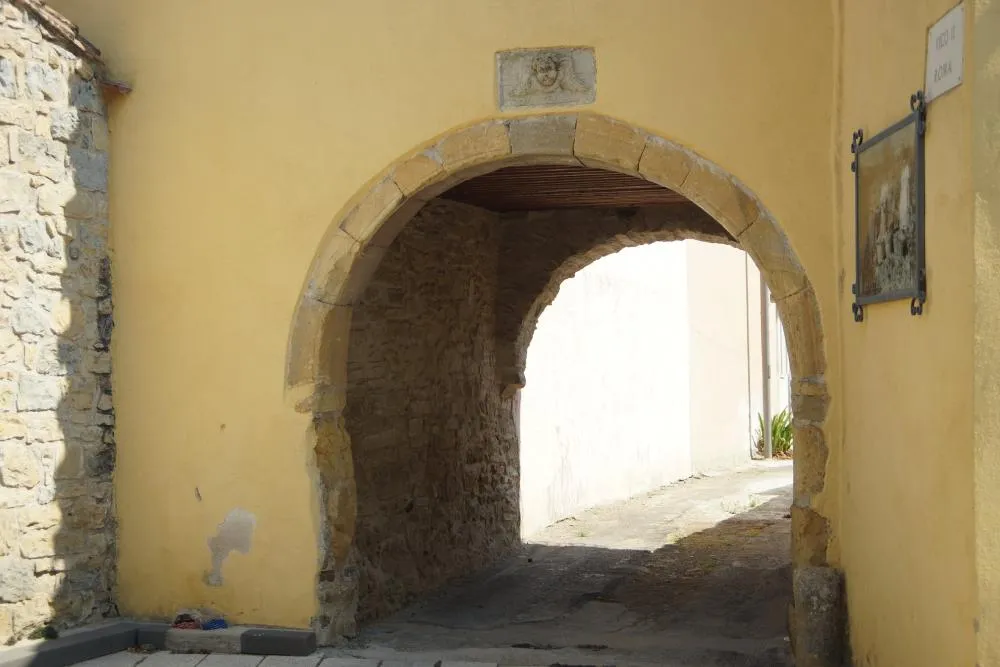

The small portal bears a bas-relief on the keystone in the form of a small, winged cherub that is said to have come from the village of Gemussi, which no longer exists. The evidence suggests that it may have been built using decorative elements belonging to the old parish church of Simala, of medieval origin, which was extended at the end of the sixteenth century.
The portal leads through a loggia to a public area overlooked by various properties. At the sides of the portal, there are rounded stone structures that acted as hinges for a large door, now missing.
At the end of the alley, a second portal can be seen with archivolt, jambs, capitals and a stone arch while, to the right, there is the entrance to an old barn, where the original ancient door made of wooden slats is marked with the initials DDT. This recalls the great campaign launched in 1946 that deployed the best-known modern insecticide against the anopheles mosquito, the carrier of the malaria virus, which claimed many victims in Sardinia.
The portal with the little angel was commissioned by a carabiniere officer born in Fonni who, after getting married, settled in Simala, where he opened a shop and a small inn with a shelter for horses. The entrance to the inn was in Via Roma, formerly Via Progresso, and was built before 1890.
The portal displays simple lines and has a large door made of wooden slats dating from that period.