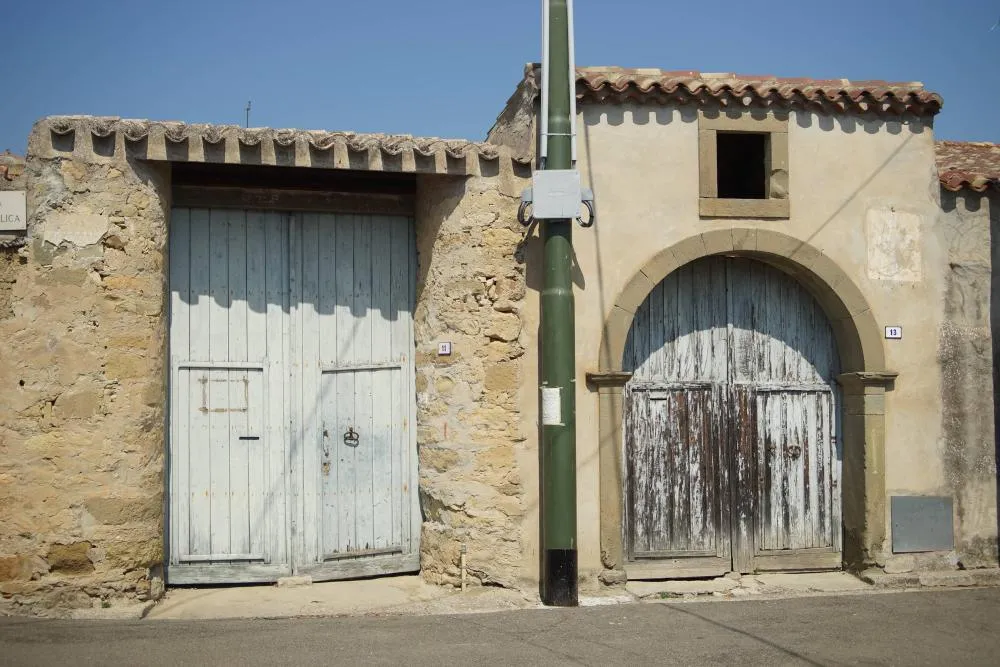
On the left, there is a classic example of a portal built with the architrave system, the evolution of which, in the history of architecture, later led to the archivolt system.
In the portal with an arch, the load-bearing elements are joined by an arch completed at the top with a so-called keystone, on which an engraving almost always reported the year of construction or the client’s initials.
In both portals, the door has two leaves, made of wooden slats.
The portal on the right is more complex and is surmounted by a dovecote with a special window edged with the same material as the portal, and a roof of Sardinian tiles.
The entrance on the left was built between 1830 and 1880. It has splayed jambs and is supported by a mixed technique wall of stone and làdiri, traditional unbaked bricks made of a mixture of clayey earth, water and chopped straw.
The bricks measure 40 cm x 20 cm x 10 cm and display a geometric ratio in which each side is half the previous one. They were only used in the upper part of a building while the base of the foundation and the masonry, at least up to a certain height, were made of stone to prevent rising damp.
In his “Tour of the island of Sardinia”, the geologist and cartographer of the Savoy kingdom, Alberto Della Marmora, wrote: “Every time one is added, the surface of the lower layer is wetted so that it acts like concrete, welding the bricks together, which makes the walls very solid.”