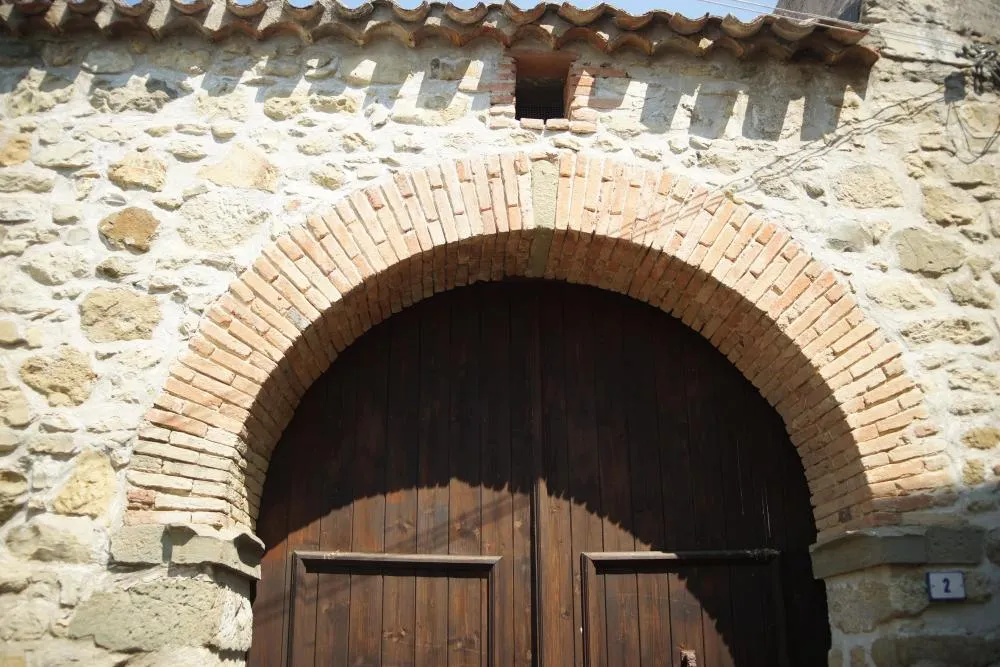
The portal has a rounded brick arch, jambs and capitals in stone. It leads to a large courtyard complex that once belonged to the Cancedda family.
The complex has great historical, architectural and environmental significance and was originally furnished with a second entrance for carriages and a pedestrian entrance to the main wing. On the death of Mario, the last direct heir, in the Mauthausen prison camp in Germany in 1918, the property was divided up and now belongs to various owners.
The entire building complex was made up of an older, eighteenth-century wing, commissioned by Giuseppe Cancedda, a major landowner born in 1787, and a palace in the neoclassical style that belonged to his grandson Eugenio, Mario's father, who died in 1916.
The oldest residence, “is domus”, a term of Roman origin that, in the Campidano dialect, indicates the individual rooms of the eighteenth-century house, is made up of two storeys and features a classic portico with arches.
Built facing the entrance portal, it is surrounded by a huge courtyard that slopes down towards the public road and was paved with a series of stone elements arranged to form two small drainage channels that allowed rainwater to run off into the road. Separate from the house, there are several rustic outhouses and loggias that occupy one wing of the large courtyard.
These were used as shelters for the animals and for storing the implements required for farm work. There is also a vegetable garden and a citrus grove. A room adjacent to the building was purpose-built in the nineteenth century to house an olive press with a large stone wheel that was turned by a donkey or a horse.