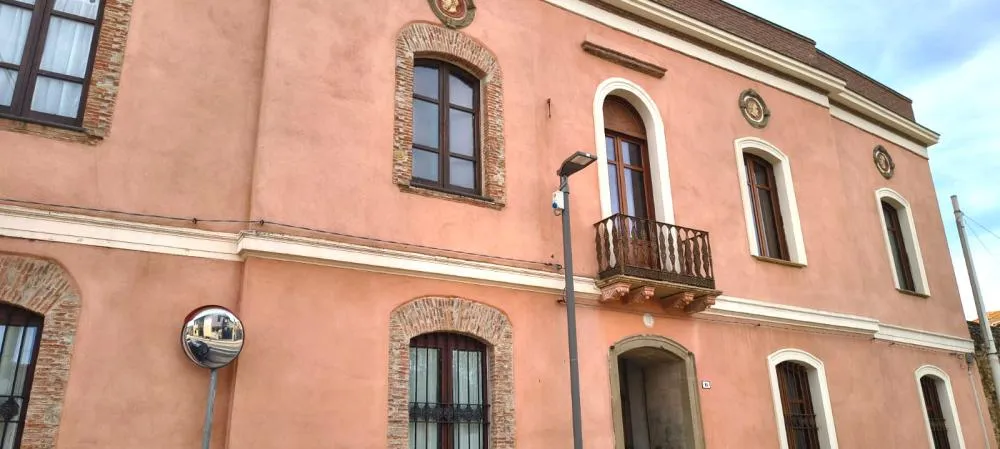
The design of this elegant residence was based on models already seen in the town at the beginning of the nineteenth century and was part of a much larger complex, presumably erected between the end of the eighteenth century and the start of the nineteenth century, commissioned by various members of the Cancedda family.
It is almost certain that the construction of the palace was commissioned by the lawyer Salvatore Cancedda, who died in 1888. Its design is attributed to the architect Gaetano Cima from Cagliari, or to his school, and it was built to celebrate the wedding of Salvatore’s son Eugenio in 1886.
Eugenio Cancedda, a Praetor of Iglesias, that is, a high-ranking church official, and a Court Judge, died in 1916. A period of mourning was followed in 1918 by the departure of his son Mario to serve as a volunteer in the First World War. The young man left with the intention of “serving the homeland” but was taken prisoner of war and interned in Mauthausen, where he died. He was buried in the local Italian Military Cemetery.
The judge’s widow was the sole heir to a large estate and, after a series of events, she decided to dispose of ownership of both the land and the residential complex. Today, the latter belongs to various Simala families who have no bonds of kinship with the original owners.
Judge Eugenio Cancedda's wealthy family is also noteworthy for the substantial donations made by his widow in 1922 and 1935 in favour of the San Giovanni di Dio hospital in Cagliari, designed by the architect Gaetano Cima and built in the second half of the nineteenth century.
Her generosity is commemorated by a marble plaque placed in the hospital’s entrance hall.